June 18th, 2015 §
About nine months back in invested in a Ricoh Pentax 645z camera body, and purchased nearly every medium format lens available (from super wide 25mm (approx 19mm in 35mm equiv.) to 400mm tele) for this wonderful new camera. I thought it was time to talk about the joy I’m getting from the amazing output quality I’m seeing.

I used to shoot medium format film cameras up to 6 x 9 colour transparencies. Shooting 35mm full frame digital is great, but when Ricoh Pentax brought out this camera I felt it was time to jump up. Sure, Canon has recently unveiled 50MP 35mm camera bodies, but to be honest, they won’t come close to the performance of this. The file sizes might be comparable, but the pixel size with the Canon is so small now, that the quality of output will be miserable in comparison. Check out the photo below for a large copy (which is 1/10th the size of the original by the way) – click on it and make sure you’re viewing at 100%. As you see, there’s no shadow detail. Infact, I’m finding I can shoot the Pentax 645z at 3200 ISO and the files are better than the best Canon 400 ISO files I’ve seen. It’s just luscious to shoot with and I still marvel at the results every day.

Incredible image quality – click for full screen view – make sure you have 100% viewing
It’s been a big investment in equipment, but as we specialise in very large reproductions (especially doing a lot of giant murals for clients) and have always aimed for the best quality output. It’s why we also maintain a top of the line Hasselblad Imacon Scanner for sucking the best out of our back collection of quality transparencies. The feedbck we’ve had from clients is very rewarding.

Pentax 645z in action. Rob Suisted, Kaimanawa Forest Park
September 15th, 2014 §
Auckland City Hospital’s Motutapu Ward, the new Northern Region Haematology and Bone Marrow Transplant Unit, is using over 20 of our large murals.
The stunning facility has been co-designed with patients and has a range of unique features which have set a new standard in patient centred care. Former leukaemia patient and fundraising ambassador, Molly Rowlandson, says the new ward has exceeded all her expectations. ADHB press release
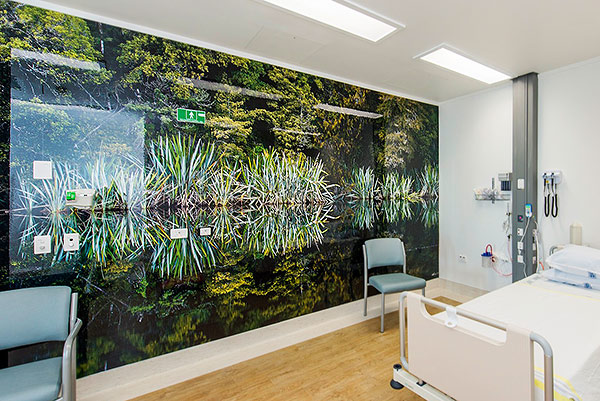
Relaxing NZ flax wetland reflections ©Rob Suisted – www.naturespic.com
More research is showing that quality images of nature are important to our well being, and important in our lives. We enjoyed working with Klein (Architects of Specialised Environments) to get the best images – not only in subject, but in size and proportions to get the best quality reproduction.
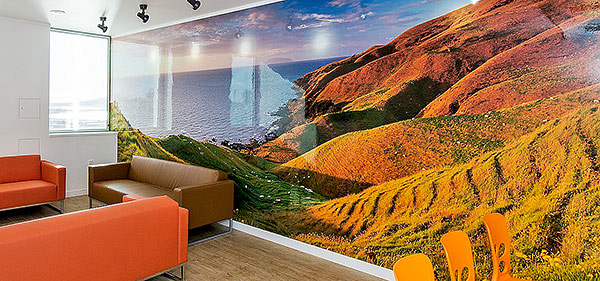
Coromandel sunset ©Rob Suisted – www.naturespic.com
There are three aspects for quality large reproductions: 1) Original image size before interpolation – i.e. the more pixels from the camera the better!, 2) reproduction size, how big is your mural going to be, and 3) viewing distance – how far is the view from the print? Viewing distance is often much neglected in consideration. E.g. a phone photo will work for a billboard size reproduction if the viewing distance is 100 metres away, but on a wall at a close viewing distance it will fail badily. If the print is viewed from a few metres then there is no substitute for professional files
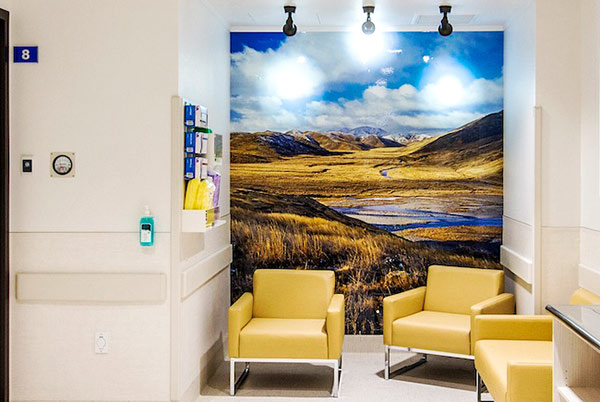
Clarence River high country ©Rob Suisted – www.naturespic.com
We work really hard to provide image files that can go large, with close viewing distances. In fact, we’ve just invested in the new Pentax 645Z camera and full set of lenses, a camera of 51 megapixels per image. Professionally stitched image panoramas will make amongst the best image files for murals available anywhere.
Several other large mural projects we’re been involved with here. Check out feedback we’re recieved from some of our mural clients.
June 24th, 2013 §
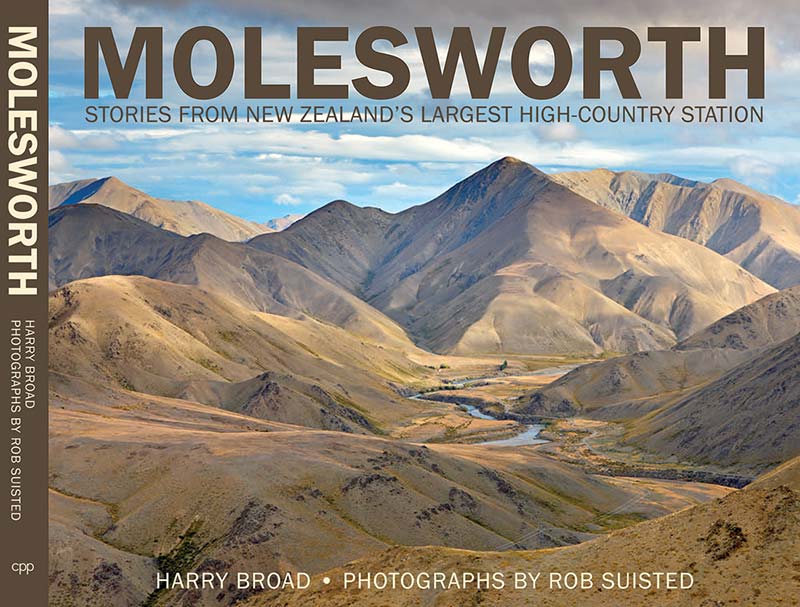
MOLESWORTH STATION, stories from New Zealand’s largest high country station, has been a 2 1/2 year journey with author Harry Broad, attempting to create a book that does Molesworth Station justice. At 500,000 acres the station is bigger than Stewart Island, and contains one of NZ’s biggest cattle herds. Here’s the first glimpse of the cover of the book, due for September release.
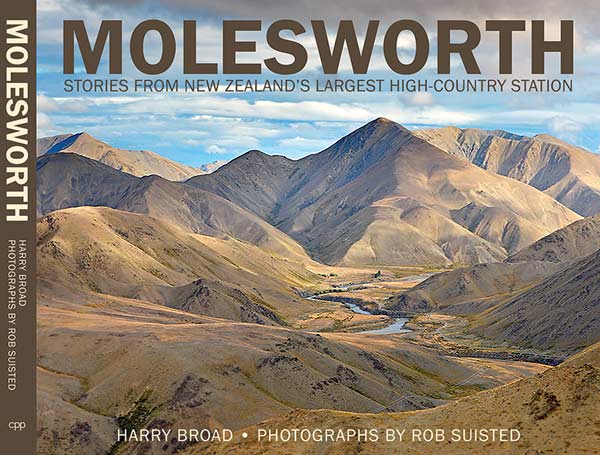
The name of Molesworth has huge national recognition, not only because it is our largest high-country station, but also because of the remarkable story of how, from the early 1940s, the legendary manager Bill Chisholm rebuilt a ruined landscape and turned it into a flourishing and profitable farm. Molesworth covers an area greater than Stewart Island, and is in every sense a working farm, home to one of the country’s largest cattle herds… > > > Continue reading : full post + comments > > >
August 3rd, 2011 §
I love most the unexpected nature of photography.
Yesterday Garry Glynn contacted me to photograph a family heirloom piece. Other photographers he’d contacted weren’t interested; I assume it being a small paying private job. I had a hunch that there was something more interesting about it, took it on, and luckily I was proved right.
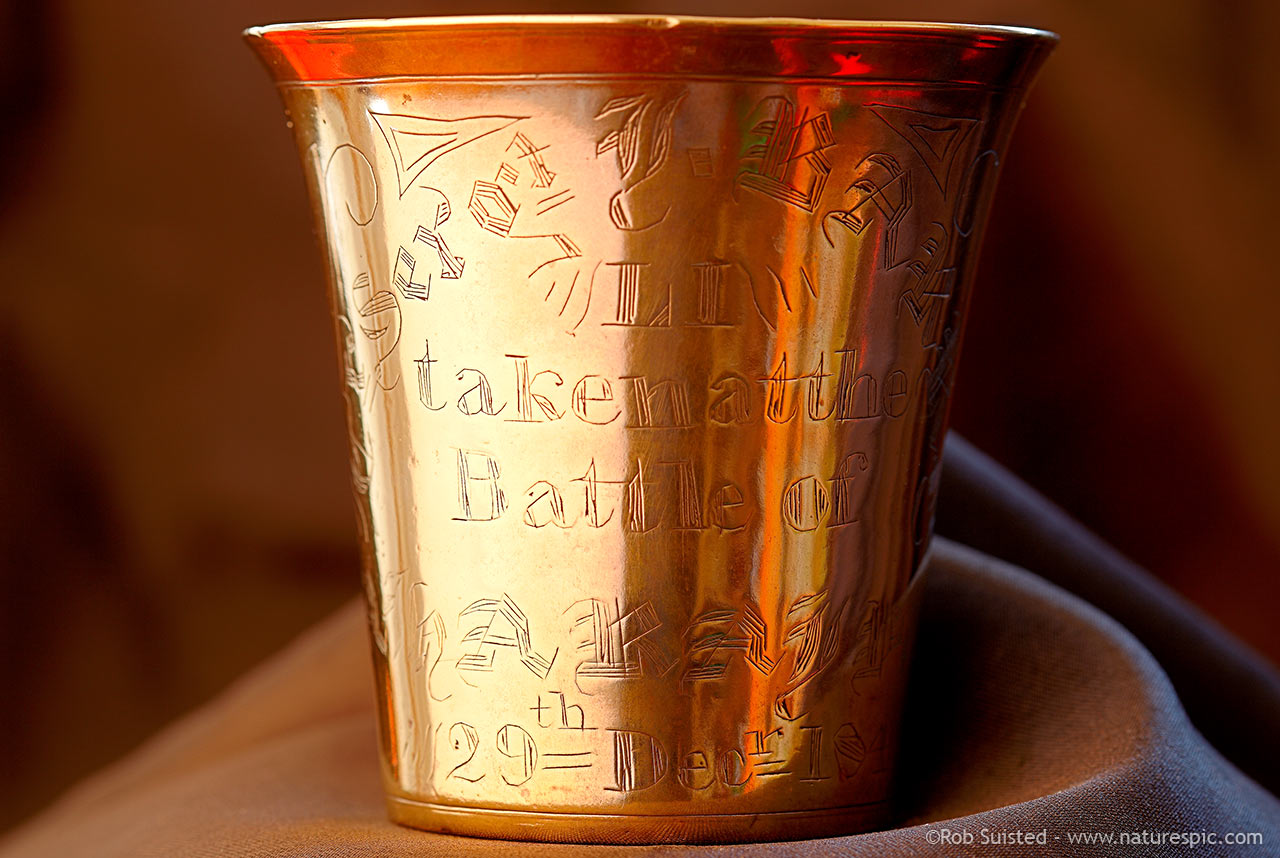
89 year old Garry arrived and delivered to my hand a small simple heavy brass drinking cup similar to many I’d used in India. Nothing special except it had engraving around the outside. It carried a story that I’m still thinking about today; a story of history and horrific human bloodshed.
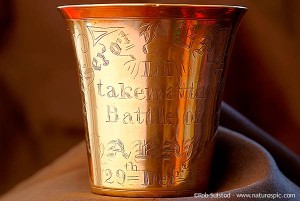
From the Battle of Mahajapore. Scroll down for result
Turns out Garry’s relative (Col Sgt J. Barry, 39th Dorestshire Regiment) was present at the Battle of Maharajpore, India, on the 29th December 1843. He was lucky to make it. 5000 people did not make it that day! In a nutshell, Central and Northern India had fallen to British forces in 1818, but Marathas in Gwalior saw the failed British campaign in Afghanistan as opportunity to regain independence. The battle ensued. It’s believed that nearly 800 Bristish soldiers and 3-4000 Marathans were killed; an unbelievable slaughter of human beings in one day. The significance of this event for the British is remembered with the Gwalior Star campaign medal.
Garry is passing this family ‘war trophy’ or heirloom down to the next generation and wanted a photo showing all the cup’s text to give to his relatives. My job was to attempt that. Given the circular object with concave face, and the highly reflective nature of the surface, the job wasn’t straightforward. But I love a challenge, and I reckon it could be done.
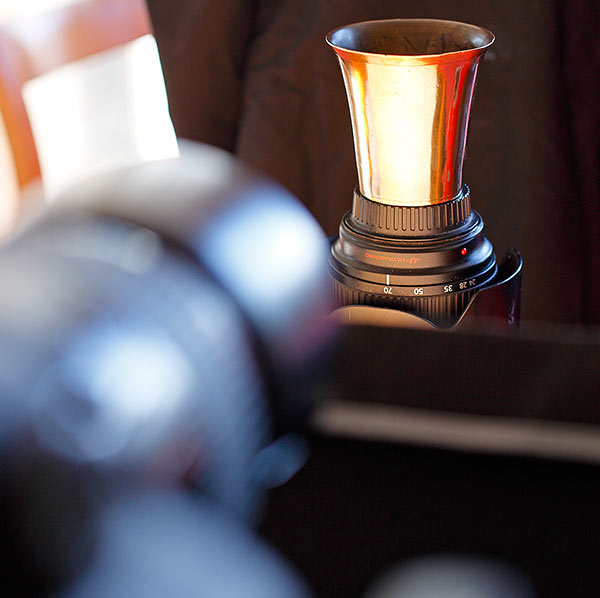
First up was to prepare the vessel. A good polish brought out a good shine, and a closely held candle flame sooted the surface up nicely, and another shine left a little soot in the engraving. Next was figuring out how to light the face of the vessel with even light. No problems there, get an Elinchrom studio light out and pop on a softbox, but trouble is that you can’t get a camera in there without interrupting the clean lighting. I tried a couple of tilt shift lenses attempting to shoot off the central axis, but this just distorted too much. Then I figured the concave front face would let me lower the softbox and shoot over the top without breaking the clean reflection – great.
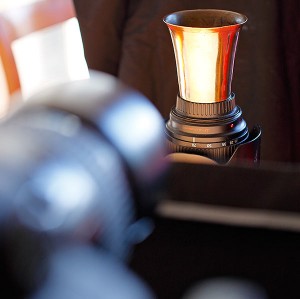
Camera shooting over studio flash and softbox
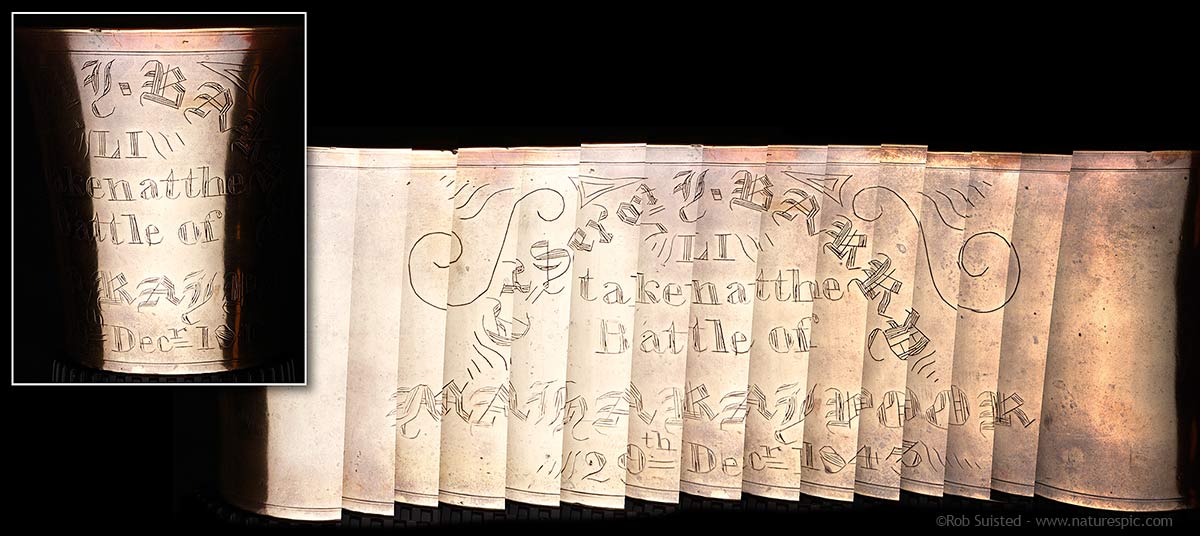
Once a nice even light was sorted, next was to carefully rotate the vessel and photograph ovelapping images. Another lens base proved to be the perfect stage.
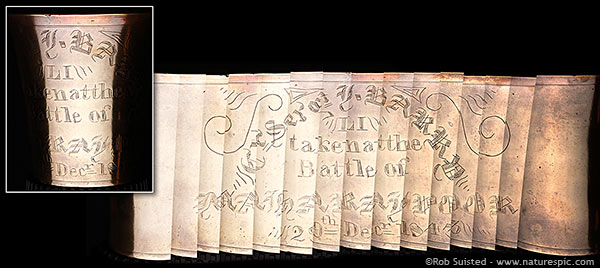
Photo slices ready to be worked up
I ran this through a panorama stitching programme and gave it a clean up. Garry just called around today and seems very happy with the result:
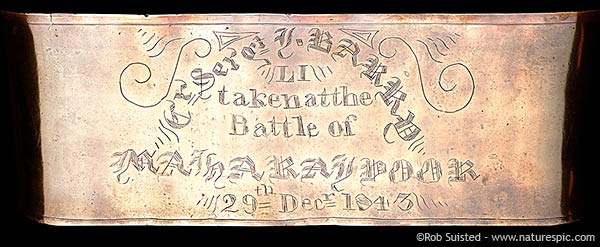
The final result
But I’ve been thinking about the cup since: what horrors and good times it has witnessed, and what route it has taken to arrive in my hands? Garry tells me that a number of ‘retired’ seasoned British soldiers were offered land in New Zealand in exchange for being willing to fight in the NZ land wars if necessary. They become known as ‘The Fencibles’, and this is the route in which the cup arrived in NZ.
I also found this gritty, stiff upper lip, description of the battle by Henry Man. It’s a short honest read that gives you an appreciation of how gnastly that day must have been. Please take a moment to read it if you can.
So, all in all, a photo job that paid for itself in not only in dollar terms, but that was also rich in knowledge, experience, and technical challenge.
December 16th, 2010 §
I just had the opportunity to photograph some remarkable animals. Kaimanawa wild horses can polarise people. They made me think.
I was a professional conservation manager before I was a professional photographer. I am well aware of the issues with these introduced animals living in an environment of high conservation values, such as these horses. This issue touched me years ago as minute taker for one of the advisory meetings on mustering the horses back in the 1990’s when scientists and managers nutted out the operational plan to manage their numbers. I’ve also studied zoology, and animal behaviour is a huge interest area given my photography. I’ve never gone out of my way for horses, and really haven’t had much to do with them.

Young Kaimanawa wild horse stallion all fired up after challenging another horse. We've made a canvas print of this boy available below.
Why am I explaining you this? Well, my recent experience was a surprise. I discovered a spirited animal with interesting behavioural traits I hadn’t expected. The horse, domesticed by man over thousands of years, again returning to a wild state & rebuilding its wild traits. I discovered a huge difference between domesticated horses, and those that run free.
The word ‘broken in’ refers to spirit I feel. I saw colts and stallions galloping kilometres across open tussock to challenge each other, and then race back. I saw stallions protecting their herd, and a mare cautiously introducing her new foal to her herd. I saw piles of horse poo stacked high as a territory or social marking. But, beyond all I saw spirit. Of course, I’m in two minds – I’m into conservation, but I can also see the other side of the argument to retain some of these animals; to have a wild animal running free – for their spirit but also ours as humans. A quandary alright; one that touches on our conservation ethic, but also strums spirited chords deep within our psyche. Both have value.
I went to photograph horses. I found a lot more.
I’m pleased to make my favourite image from the day available as a high quality canvas print. He’s really fired up and full of himself, and the flowing mane and glare in his eyes says it all.
Thank you to Peter Cosgrove for his generous gift of time and hospitality to make this trip possible. What is your view about these animals?
December 8th, 2010 §
Just had a week shooting an article on ‘Happiness‘ for the Jan/Feb 2011 issue of New Zealand Geographic Magazine.
A bit outside my normal beat, but despite initial trials and tribulations, it became a most satisfying and challenging week. Meeting, filming and spending time with such a varied group of people interested in happiness, really made me happy. Not surprising really – from a buddhist monk to a philosopher, brain researcher and even an athlete who has learnt to walk again and now shes rides ducatis for fun, it was very inspiring. I hope my images do them all justice.  Here’s a hint of what’s coming. And here’s another teaser from NZ Geographic http://twitpic.com/3bf5ed. Have a look out when the next issue arrives, and let me know what you think. I’ll be writing more on this subject. All the best, Rob
April 21st, 2010 §
This month I gave a speech at the Photographic Society national conference. I chose to talk about how photography can add to an exceptional life.
Partly I talked about how I’ve learnt that serendipity is a very important index to monitor in life and business. True to form a nice bit of coincidence appeared while researching my speech. It’s this that I want to tell you about, and why I’ve found it so vital to have.
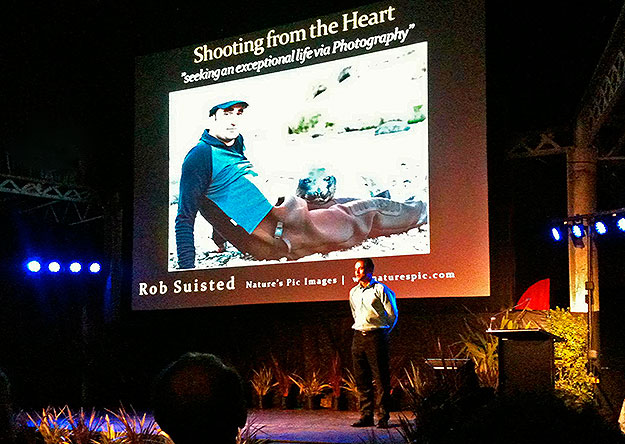
What is serendipity? I know it’s fortuitous coincidence, but what is it really? And why do some people have more of it than others? I’m very interested.
My speech was titled: ‘Shooting from the Heart – seeking an exceptional life via photography’. Of course, photography is my income, but it pays me richly in many better ways; I’ve been lucky to meet some amazing people, wildlife, visit some special places, and share great experiences so far in my life. The ‘juice of life’ is what I call it now, and it’s something that should ideally be enjoyed and sought in a pure sense, not driven by necessity or ego.
I’ve found that the more I try to discover this in a pure sense, without selfish interest, the more serendipity or coincidence appears. It might sound a bit flaky or woolly perhaps, but I can assure you that there is a sensible reason for it, and here in lies what I have learnt so far, and wish to share.
Creative professionals know that creativity comes from an open still mind. A mind that contains stress or fears becomes closed and creativity suffers. Same with opportunity, same with serendipity. I think that we all have similar portions of coincidence in our lives, but an open mind simply sees more of it. I have the confidence now to use serendipity as a powerful defacto indicator that my mind is more open, and therefore probably more receptive to opportunity and creativity. Make sense? Watch out for it and tell me what you think. Does it happen to you also? I’m very keen to know more.
A nice piece of historical serendipity to share
By happy coincidence, while researching my speech, I discovered a little bit more about an ancestor Laura Jane Suisted (1840 – 1903), and an unexpectedly fascinating link between us that spans the globe, and a century, appeared…… > > > Continue reading : full post + comments > > >
January 8th, 2010 §
I had an ephinany this morning. I poured my first decent bit of Latte Art. After months of learning and trying hard, this one just popped out without fanfare or conscious effort. I’m proud as, and its got me thinking…
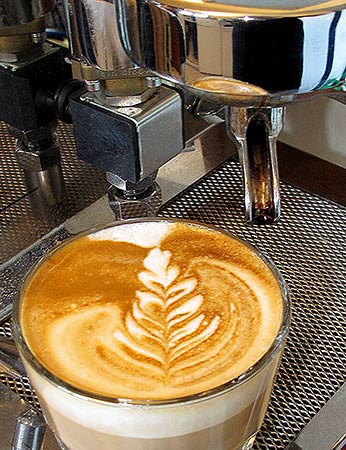
Rob's first latte art fern
Several things have been drawing coffee and photography together for me over the last few days so I’m going to make a caffeine fueled comparison.
It would be fair to say that coffee has become quite important at Nature’s Pic Images. Over the last year a brand new Vibiemme Super E-61 group head espresso machine has become a shrine to which morning work schedules often bend around. Before actually owning a coffee machine of any quality, I enjoyed a good coffee at a fav local cafe (Cafe du Parc), but I had no idea of the skill employed by Georga, Terry, and the team when making a consistently good brew. There is a lot to know and a lot of variables to deal with. I now tip my hat to a good barista.
So, why the hedonistic comparision between coffee and photography?
Both are, at the same time, technically intensive, and creatively infused. It’s an interesting blend and one that I love. To make the perfect photograph is impossible; to make the perfect brew is impossible. What do you think?
I was reading an article (for the life of me I can’t find it now) by a life long barista where he claimed to have only poured about 30 ‘God Shots’ in his career. God shots would be an espresso pour to die for I guess? There was no definition….. > > > Continue reading : full post + comments > > >



















![{Post this BLOG to Twitter]](http://blog.naturespic.com/wp-content/plugins/tweet-this/icons/tt-twitter-micro3.png)